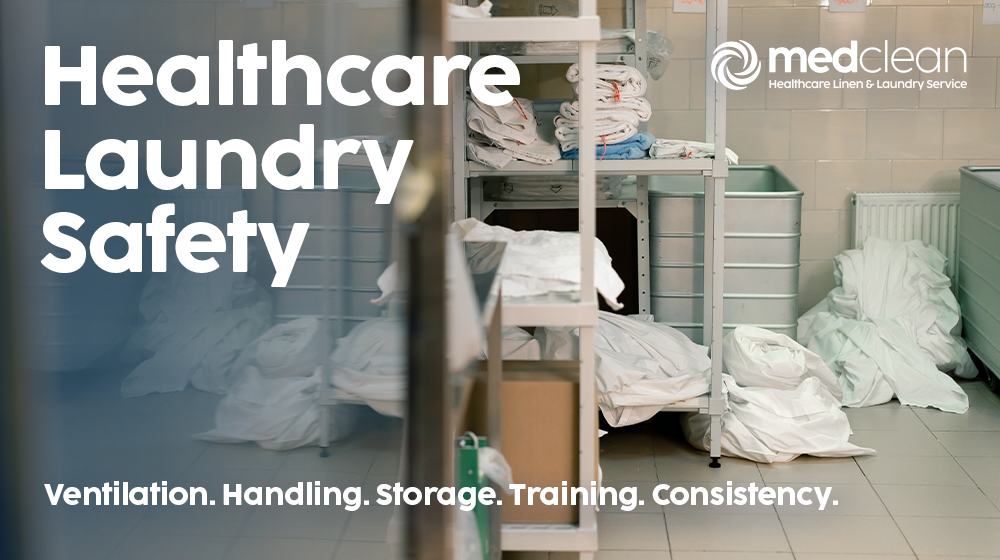
The OSHA-aligned essentials (they add up quickly)
1) Ventilation and airflow.
Laundry areas generate heat, humidity, and lint. Airflow is a safety control, not just a comfort issue.
What “good” looks like:
- Clear separation between soiled and clean areas
- Airflow that supports that separation
- Routine checks, so “it used to work” doesn’t become the standard
Why it’s tough internally: HVAC issues do not announce themselves politely. You often discover problems when staff are already uncomfortable, lint is building, or odors become a complaint.
2) Contaminated linen handling.
This is where small shortcuts create big exposure risk.
What “good” looks like:
- Bagging/containment at the point of use
- Minimal handling and controlled movement
- PPE and hand hygiene that are easy to follow in real workflows
Why it’s tough internally: Compliance depends on consistency across shifts, departments, and staffing changes. Training once is not the same as maintaining a standard.
3) Laundry chemical safety: getting serious about Hazard Communication
Healthcare laundry chemistry is effective because it is strong. That means it needs strong controls too.
What “good” looks like:
- Correct labeling on every container, including secondary bottles
- SDS access that is fast and obvious
- Training that covers real scenarios (dilution, storage, spills, “do not mix” situations)
Why it’s tough internally: Turnover and “tribal knowledge” are the enemy here. If one experienced person always handled chemicals correctly, what happens when they are on vacation, are out sick, move roles, or retire?
4) Fire prevention: lint is not “just housekeeping.”
Lint is a predictable hazard that shows up over time, not suddenly.
What “good” looks like:
- Lint traps cleaned on schedule
- Weekly “behind and above equipment” checks
- A simple documented checklist that gets done even on busy days
Why it’s tough internally: In-house teams often run short. When production pressure spikes, little details, such as lint control, are among the first things to slip.
5) Slips, trips, and wet-floor realities.
Laundry spaces are inherently wet, making them inherently risky for injuries.
What “good” looks like:
- Floors kept as dry as practicable
- Drainage issues are treated as urgent maintenance items
- Walk paths that stay clear because carts and bins have “homes.”
Why it’s tough internally: If your laundry is squeezed into a limited space, you are constantly fighting physics and traffic patterns.
6) Clean storage and “clean stays clean.”
Clean linen must remain protected from recontamination. That is a flow issue, not just a shelf issue.
What “good” looks like:
- Clean storage separate from soiled intake
- Covered carts or protected storage where possible
- Routine cart cleaning and clear handling rules
Why it’s tough internally: It only takes one “temporary” habit to become permanent. Clean carts are parked in the wrong place. Soiled and clean crossing paths. A storage room that is overflowing.
The takeaway
If reading this makes you think, “We do some of this, but not all of it,” you’re not alone.
The challenge with in-house laundry is not knowing what to do. The challenge is doing it every day, on every shift, with documentation, training, maintenance, and staffing stability.
That’s why many healthcare facilities are moving toward partners like MedClean. Not because their teams do not care, but because the system is complex and the risks are real.
How MedClean helps reduce laundry-area risk
When you work with MedClean, you gain a partner whose entire operation is built around consistent standards and repeatable processes, as verified by our HLAC accreditation.
Facilities partner with us to:
- Reduce dependence on “one person who knows how everything works.”
- Strengthen compliance confidence through consistent procedures.
- Support staff safety by removing high-risk laundry tasks from the building.
- Protect clean textiles through controlled handling and delivery practices.
- Simplify oversight with one accountable partner.
If your laundry leader retired tomorrow, would your program run the same next week? If the answer is “maybe,” that’s your signal.
Ready to simplify your laundry program without lowering your standards?
MedClean supports healthcare providers across the Chicago area with hygienically clean linen, uniforms, and patient garment services designed to reduce risk, protect staff, and maintain consistent textiles.
Let’s talk through your current setup and goals.
- Request a quote
- Or schedule a quick laundry program review
Contact MedClean today to see what a safer, more reliable laundry program can look like.
Resources:
Centers for Disease Control and Prevention (CDC) – “Guidelines for Environmental Infection Control in Health-Care Facilities, Laundry and Bedding” https://www.cdc.gov/infection-control/hcp/environmental-control/laundry-bedding.html
Occupational Safety and Health Administration (OSHA) – “Hospitals eTool, Laundry” https://www.osha.gov/etools/hospitals/laundry